
A ceramic tiles manufacturer sample can demonstrate an appealing relief pattern without showing how the finished wall will be maintained. For hotel lobbies, retail interiors and commercial reception areas, buyers should assess routine cleaning access before awarding the order. Selecting a surface that the facilities team cannot practically reach or maintain can transfer an unresolved procurement decision into daily operations.
This buying guide focuses on maintenance trials for decorative 3D ceramic walls. It is not a cleaning-product recommendation or a promise that every glazed surface is easy to maintain. The aim is to establish what evidence, instructions and access arrangements the project needs before a finish becomes an installed commitment.
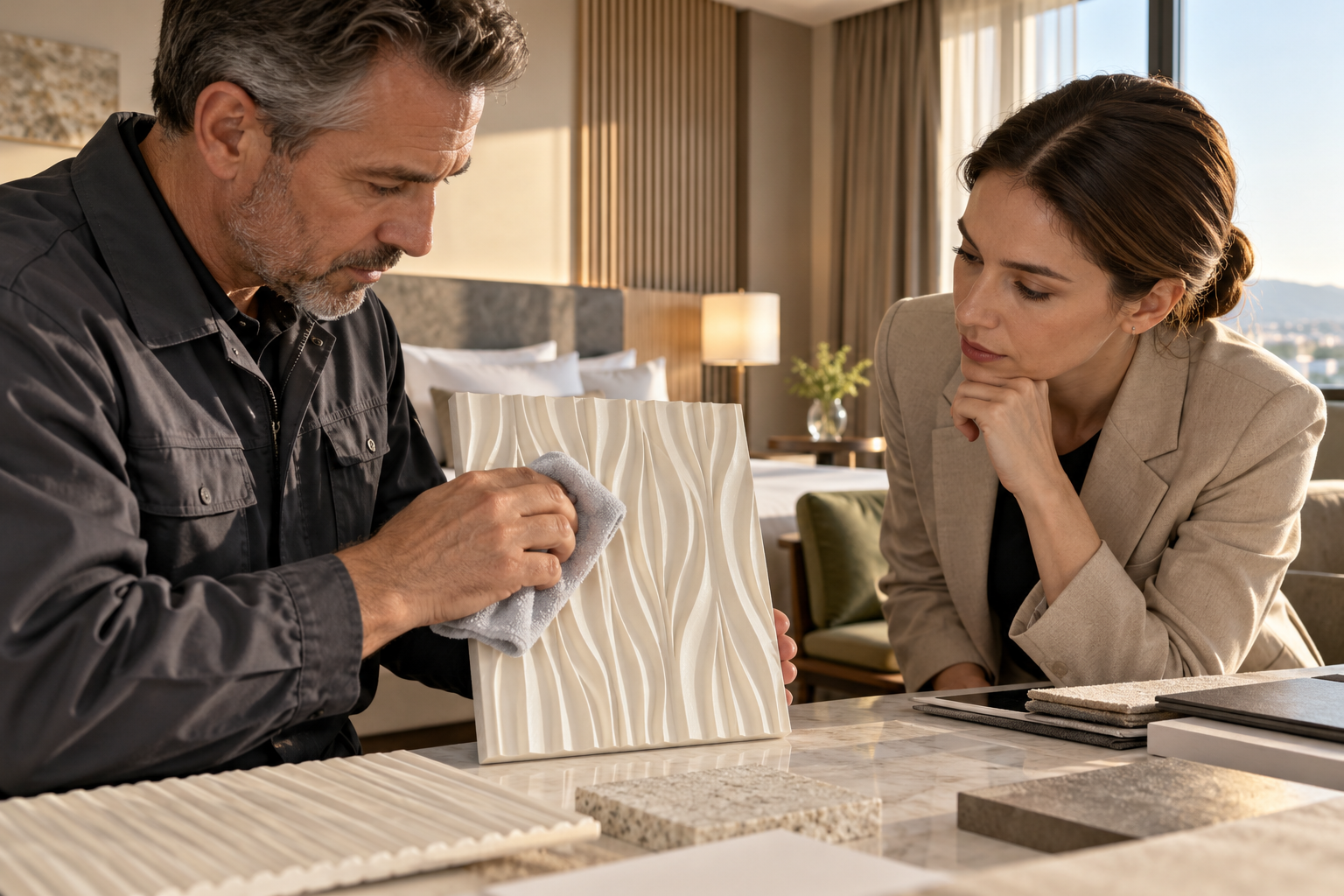
Original illustrative maintenance-review scene, not a documented MagiTiles installation.
Ask What the Trial Needs to Demonstrate
Start with the proposed application rather than a generic cleanability claim. A high-level feature wall in a lobby has different maintenance exposure from a low wall beside a busy entrance. Identify likely dust, touch points and adjacent finishes, then have the facilities team describe the routine maintenance they expect to perform.
Agree the questions the trial must answer. Can the intended tools reach the relief grooves? Can the surface be inspected under normal lighting after maintenance? Will the access arrangement fit around furniture and circulation routes? Record these as project questions, not as universal pass criteria that apply to every ceramic product.
Use MagiTiles ceramic tile sourcing insights to organize the buying discussion alongside drawings and operational requirements. A supplier’s general guidance is useful context, but the trial should address the actual proposed finish and location.
Obtain Product-Specific Instructions First
Request written care guidance for the proposed product, including any limitations relevant to the finish. Ask how construction residues should be addressed and how that process differs from routine maintenance. Have the responsible specialists confirm compatibility with grout, sealants, trims and adjoining materials.
Do not infer an approved method from the word ceramic or from the appearance of a sample. Avoid introducing an unapproved chemical, abrasive tool or procedure simply to make a demonstration look successful. The project team should use the product instructions and qualified advice to establish the trial method.
For a 3d ceramic tiles manufacturer inquiry, include the relief profile, orientation and intended installation height. A care sheet for a different flat tile may not address practical access to the proposed geometry. Ask the supplier to identify what guidance applies and where a project-specific review is still needed.
Build a Representative Maintenance Mockup
Use enough modules to include repeated grooves, joints, edges and a representative return. A single loose tile can be convenient for an initial discussion but cannot demonstrate access across a completed wall assembly. Keep the approved product identity and mockup revision clear.
Include relevant adjoining materials where practical. Grout color, edge profiles and nearby metal or painted surfaces can affect the maintenance process. The objective is to understand the assembled finish, not to test one isolated surface while ignoring the components that will surround it.
Review MagiTiles ceramic tile project cases for application ideas, then distinguish those visual references from maintenance evidence. A photograph can show an attractive wall but does not prove the tools, time or access arrangements needed to care for it.
Separate Product Characteristics from Operational Evidence
ISO 13006 ceramic tile classification and characteristics provides standards context for specifying ceramic tiles. The project should identify applicable requirements and supporting product evidence. This editorial reference does not imply ISO certification of MagiTiles or establish compliance for a particular product without documentation.
Product evidence and an operational maintenance trial answer different questions. A report may address a defined characteristic without demonstrating how a facilities team will reach a high relief panel behind a reception desk. Keep the relevant technical documents, but do not use them as a substitute for practical access review.
Keep product categories distinct as well. An alumina ceramic tiles manufacturer inquiry may concern industrial wear linings, not architectural decorative walls. Guidance for that application should not be carried across without technical justification. A brick ceramic tiles manufacturer offer also needs evaluation against its actual material, texture, module and joint arrangement rather than a shared marketing term.
Record the Method and the Result
Before the trial, record the sample identity, assembled details, intended method and viewing conditions. During the review, note whether tools can reach the surfaces and joints, where access is awkward and whether the proposed sequence is workable. Keep photographs that identify the location and conditions rather than only a carefully selected close-up.
If effort or time is measured, describe the trial area and limitations. A small mockup result should not be presented as a guaranteed maintenance rate for an entire building. Furniture, public access, setup, dismantling and working height may substantially affect the real task.
Have the designer and facilities representative review the result together. The designer can assess the visible finish while the facilities team assesses practicality. Where concerns remain, document them as unresolved items rather than treating attendance at a demonstration as unconditional acceptance.

Original illustrative access-planning scene. Actual work access must follow the project’s approved arrangements.
Include Access in the Buying Decision
Check the wall height, adjacent furniture and space needed for the proposed access arrangement. The correct solution may involve design coordination rather than a different tile. Ask who will provide, store and operate any necessary equipment, and have competent project personnel confirm the arrangement.
Consider whether access requires temporary closure of an entrance, movement of furniture or protection of surrounding finishes. These operational dependencies should be visible before award. Do not describe a wall as low maintenance while excluding the work needed to reach it.
Review MagiTiles ceramic tile factory information when discussing product and customization options. Ask for order-specific confirmation if a different relief profile or finish is proposed. A capability statement does not establish that an alternative will meet the project’s maintenance requirements without review.
Compare Suppliers on the Same Trial Basis
Give shortlisted suppliers the same application brief and evidence request. Identify the proposed product, maintenance guidance, mockup scope, access questions and decision owners. Record which evidence is included in the offer and which activities need separate agreement.
Geographic searches do not resolve maintainability. Buyers researching a ceramic tiles manufacturer in bikaner or a ceramic tiles manufacturer in morbi still need product-specific documentation and a representative review. These phrases are examples of research queries, not claims about MagiTiles factory locations or proof that regional products are interchangeable.
Avoid comparing one supplier’s documented trial with another supplier’s informal assurance as though they were equivalent. Where evidence is missing, identify the gap and the action required. An unknown result is not automatically a failure, but it should not be silently scored as a confirmed benefit.
Carry the Accepted Method into Handover
Once the finish is selected, retain the approved guidance, mockup record and access assumptions with the project documentation. Identify who will receive them and where the facilities team will find them after handover. A trial has limited value if its method disappears when the contractor leaves site.
If the product or detail changes later, revisit the maintenance assumptions that depended on it. Do not transfer acceptance from one relief profile or finish to another without checking the differences. Include any relevant replacement-piece identity and retained reference so future repairs do not introduce an unreviewed surface.
A useful 3D ceramic tiles manufacturer buying decision looks beyond an attractive sample and a unit price. It establishes a finish that can be assessed, reached and maintained under the project’s actual operating conditions. That evidence gives contractors, designers and owners a clearer basis for award without turning a general product claim into an unsupported long-term promise.