
A ceramic tiles manufacturer quotation usually starts with the area required for installation. A project buying decision should also cover the material needed after handover. A damaged tile beside a hotel doorway, a service-access repair or a later tenant alteration can become expensive if the replacement does not match the installed surface. Spare-stock planning connects the purchase order with the building’s maintenance needs instead of treating unopened cartons as accidental leftovers.
This buying guide focuses on replacement continuity: which material to reserve, what evidence to retain, who owns it and how it will be found when a repair is needed. It is a different decision from construction wastage or shipment release. Resolve it before the order closes, while the approved production identity and purchasing responsibilities are still available.

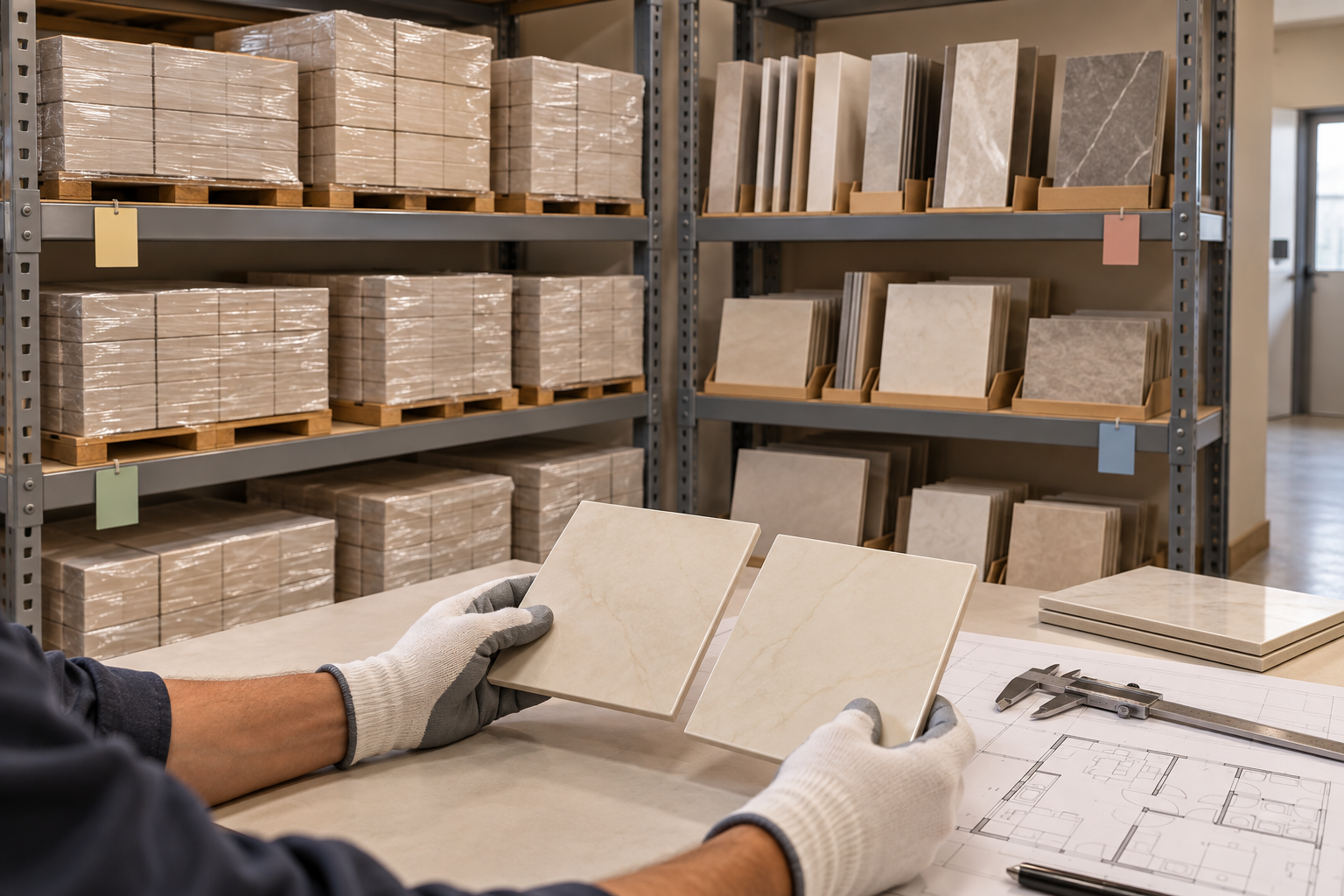
Original illustrative project scene, not a photograph of a completed MagiTiles project.
Separate Installation Allowance from Maintenance Reserve
Installation allowance covers cutting, layout losses, breakage and agreed site contingencies. A maintenance reserve is stock deliberately retained for future repairs. Counting the same cartons in both budgets creates a false sense of security: the installer may consume the entire allowance before practical completion.
Create separate schedule lines for net installed quantities, installation allowance, mockup requirements and maintenance reserve. Define the unit consistently, whether pieces, cartons or square meters, and account for the actual carton packing. State when the reserve becomes unavailable for routine installation and who may authorize any exception.
There is no universal reserve percentage suitable for every project. Consider the number of tile references, repair access, likely damage locations, custom finishes, production continuity, storage capacity and the consequences of a visual mismatch. An owner may need only a small quantity for an easily replaceable standard finish but a more deliberate reserve for a custom relief wall. Have the contractor, designer and facilities team agree the assumptions rather than copying a percentage from another building.
Reserve by Installed Identity, Not by Marketing Name
A collection name is not a reliable replacement specification by itself. Record the product code, dimensions, thickness, finish, color reference, production batch, shade and caliber markings where applicable. Include orientation, edge treatment and special pieces. A carton marked with a familiar design name can still be unsuitable beside an installed batch.
For a decorative wall sourced through a 3d ceramic tiles manufacturer, identify the relief profile and its direction as well as the color. Light and shadow may reveal a mismatch even where two sample pieces look similar on a table. Keep photographs of the installed assembly and a retained physical reference under the agreed viewing conditions.
Brick-format ceramic finishes require their own piece and joint schedule. A search for a brick ceramic tiles manufacturer does not establish that a proposed replacement has the same module, edge profile or installation build-up. Specify the actual construction product and its documented identity, not the search phrase used to find suppliers.
Decide Which Repairs the Reserve Must Support
Start with realistic maintenance scenarios. Door thresholds, luggage routes, service areas, removable panels and locations around equipment may have different repair exposure from a quiet feature wall. Ask how many adjacent pieces might need removal to access the substrate or replace one damaged tile. A reserve sized only for the visibly broken piece can underestimate the repair scope.
For relief walls, map repeated modules, left and right returns, corner transitions and pieces cut around service openings. A carton of flat field tiles will not replace a discontinued profiled corner. Ask the designer to identify which components need dedicated reserves and whether future cutting of a standard module is acceptable. Keep a small assembled reference of the approved relief sequence where practical, because an isolated spare piece may not explain the intended orientation.
Do not assume tiles are interchangeable across different applications. Industrial wear linings discussed under alumina ceramic tiles manufacturer searches are a separate technical category from architectural wall and floor finishes. Their material selection, fixing system and service requirements need a dedicated specification. Keep such products outside the decorative tile reserve unless the project actually includes them.
Review MagiTiles ceramic tile project cases for application context, then ask for evidence relevant to the proposed repair conditions. A project photograph can show a layout idea, but it does not prove spare-stock availability, a retained batch or future replacement capability.
Put Replacement Responsibilities into the Purchase Order
The purchasing package should identify the reserve quantity for each reference and the agreed basis for selecting it. If the project needs matching stock from the installation production batch, say so explicitly and require the corresponding identification evidence. Do not rely on a general promise that an equivalent item can be reordered later.
Assign responsibility for selecting, checking, packing, paying for and receiving the reserve. Define whether it travels with the main shipment or in a separate delivery, and whether it is transferred directly to the owner. Specify how shortages or damaged reserve cartons will be resolved before the procurement package is closed.
Use MagiTiles ceramic tile factory information as a starting point for supplier capability questions. Request written confirmation of any custom mold retention, sample retention, minimum reorder quantity or lead time relevant to the job. These are commercial arrangements to confirm for the specific order, not automatic benefits implied by a manufacturer description.
Preserve Technical Evidence Without Overclaiming Certification
Keep the approved product submittal, relevant test records and purchase specification with the reserve register. ISO 13006 ceramic tile classification and characteristics provides standards context for ceramic tile requirements; the project must identify the applicable classification, test evidence and acceptance criteria. A standard reference does not demonstrate that MagiTiles or any supplier holds a particular certification.
Technical compliance and visual compatibility answer different questions. A replacement may meet a technical requirement but still look different beside the existing installation. Record both the applicable performance requirements and the agreed visual review process. Do not substitute a generic certificate for a comparison with the retained sample and installed area.
Geographic supplier searches also require careful interpretation. Buyers comparing a ceramic tiles manufacturer in bikaner or a ceramic tiles manufacturer in morbi should ask the same replacement-continuity questions. These are examples of buyer research queries, not claims about MagiTiles factory locations or evidence that products from a region are interchangeable.
Original illustrative storage scene. Final storage conditions must follow the product and project requirements.
Make the Reserve Findable and Usable
A maintenance reserve has little value if its location or identity is lost. Mark cartons with a durable project reference and retain original batch labels. Store tiles in suitable protected conditions following the supplier’s guidance, with safe support and access. Avoid treating a damp, exposed corner of the site as permanent owner storage.
Prepare a simple register linking each tile reference to the installed area, quantity received, storage position, batch identity and supporting documents. Include retained sample locations and a responsible contact role. Use a building-owned document location rather than depending solely on one contractor’s personal inbox.
At handover, count usable stock rather than merely recording unopened cartons. Check for transit damage and confirm that special pieces are included. Obtain acknowledgement from the receiving facilities team. If reserve material is later issued, record the location, quantity and remaining balance so that the first repair does not quietly exhaust the stock.
Agree a Reorder Path Without Promising an Exact Future Match
Ask what happens when the reserve is consumed. A supplier may retain product information, but future availability, batch appearance, production economics and transport conditions can change. Request current reorder terms and record what is confirmed, what is estimated and what is not guaranteed.
For a custom design, discuss whether relevant tooling or reference samples will be retained, by whom and for how long. Confirm any storage charges or ownership restrictions in writing. Do not describe a possible future production run as guaranteed identical replacement stock unless that obligation is explicitly supported by the agreement.
When later material is required, compare a proposed replacement with the retained reference and the actual installed surface before ordering the full repair quantity. Aging, cleaning history, lighting and adjacent materials can affect the perceived result. The designer or owner should approve any visible compromise, alternative repair boundary or larger-area replacement.
A Better Buying Brief for the Next Project
Before comparing final quotations, send each shortlisted supplier the same reserve schedule and maintenance assumptions. Include drawings, tile references, quantities, special pieces, required batch identity, retained samples, storage ownership and the expected handover evidence. This makes the reserve a priced project requirement rather than an unbudgeted request near completion.
Use MagiTiles ceramic tile sourcing insights to structure the procurement discussion alongside the project’s drawings and technical schedule. Evaluate product direction first, supplier capability second and the order-specific reserve arrangements third. Require documented answers instead of accepting general statements about long-term service.
A sound ceramic tiles manufacturer buying decision does not end when the installation quantity arrives. It leaves the owner with identifiable, protected material and an honest replacement plan. That practical continuity can matter more during a repair than a small saving on cartons that were never reserved in the first place.