A ceramic tiles manufacturer can quote the right nominal size, finish, and unit price while still being the wrong partner for a demanding project. This is especially true when a buyer evaluates a 3d ceramic tiles manufacturer for a lobby, retail wall, hospitality interior, or large public space. A datasheet describes the product in controlled terms. The finished wall, however, depends on repeatable relief geometry, shade control, packing logic, installation planning, and timely decisions across several production lots.
Price and headline specifications remain important, but they are only the entry ticket. Contractors and sourcing teams need to test how a supplier turns approved design intent into consistent material at site. The practical question is not simply, “Does this tile meet the stated specification?” It is, “Can this manufacturer maintain the approved result through sampling, production, delivery, installation, and replacement?”
Why a compliant datasheet can still produce a disappointing wall
Most comparisons begin with easy-to-tabulate fields: dimensions, water absorption, breaking strength, finish, packing quantity, lead time, and price. Those fields help narrow a supplier list, but a 3D surface adds visual variables that are difficult to capture in a spreadsheet.
Relief depth may be technically within tolerance while the shadow line changes from module to module. Two batches may share the same color code yet look noticeably different under raking light. An acceptable individual tile may create a visible step when repeated across a large elevation. Even carton orientation affects installation speed when modules have a directional pattern.
This is why buyers should review a supplier’s ceramic tile factory and production controls before treating the quotation as final. The objective is not a ceremonial factory tour. It is to understand where the critical project characteristics are controlled, who records them, and what happens when the result begins to drift.
Start with the visual control standard, not only the product code
For architectural tiles, the approved sample should become a working control standard. A useful approval package contains more than one attractive piece. It should define:
- The approved color range under agreed lighting conditions.
- The relief profile, maximum projection, and permitted variation.
- The module orientation and intended repeat sequence.
- The joint width, grout color, and edge condition.
- The substrate, adhesive, fixing method, and movement-joint assumptions.
- The viewing distance and the elevations where appearance is most critical.
Ask the manufacturer to keep a signed reference sample and photograph the approved control board under repeatable lighting. The buyer, factory, and installer should refer to the same version. If the sample changes, record the change rather than relying on messages scattered across different chat threads.
This discipline applies beyond decorative wall tiles. An alumina ceramic tiles manufacturer may control wear performance, density, and geometry for industrial linings, while a brick ceramic tiles manufacturer may focus on tonal range, edge character, and firing consistency. The measured characteristics differ, but the operating principle is the same: define what matters, agree on how it will be checked, and preserve traceability.
Evaluate process capability behind the price
A low quotation can reflect genuine manufacturing efficiency. It can also hide a narrow quality-control plan, mixed raw-material lots, rushed firing, insufficient sorting, or packaging that transfers risk to the jobsite. Buyers do not need to audit every process detail, but they should request evidence for the controls that protect their project.
1. Incoming material and body preparation
Changes in raw materials and moisture can affect firing behavior, dimensions, color, and warpage. Ask how the factory identifies material lots and how production records connect the finished cartons to those lots.
2. Mould and forming stability
For 3D tiles, mould wear can gradually soften relief edges or change the module fit. Confirm how the manufacturer checks mould condition, defines replacement criteria, and compares early and late production output.
3. Kiln and finishing control
Temperature distribution, firing curve, glaze application, and surface finishing all influence appearance and performance. A supplier should be able to explain its inspection frequency and escalation method without hiding behind a generic “strict QC” statement.
4. Sorting and lot separation
Shade and caliber sorting should match the project’s installation plan. Cartons need lot identification that remains readable after warehouse handling. If several production lots are unavoidable, the delivery plan should prevent uncontrolled mixing on one prominent elevation.
5. Final inspection and release
Agree on the inspection level, acceptance criteria, sampling method, and photographic record before production. International management-system standards can support a supplier’s operating framework; buyers can consult the International Organization for Standardization for authoritative information about ISO standards. Certification, however, does not replace product- and project-specific acceptance criteria.

Use a mock-up to connect factory quality with site reality
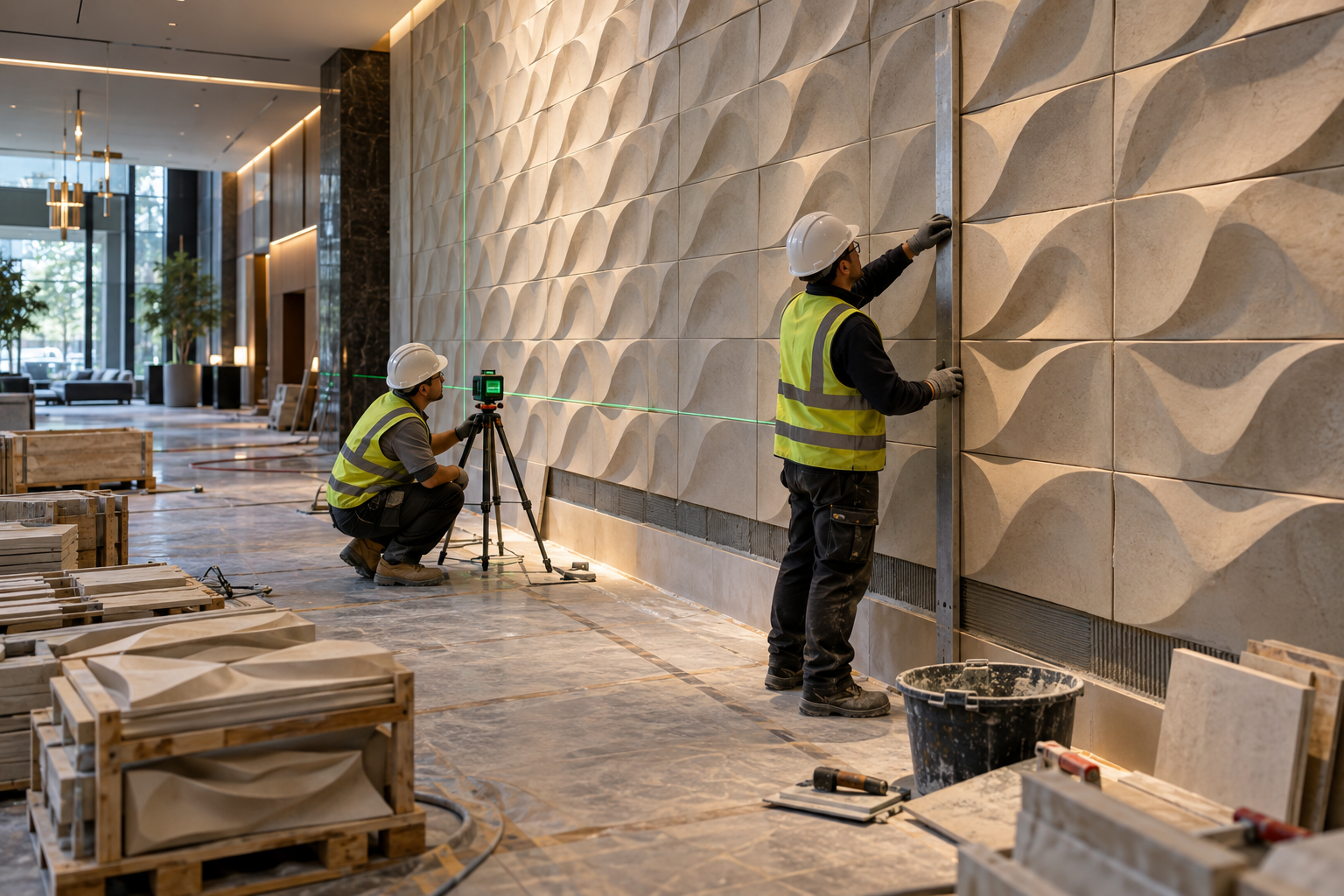
A mock-up is one of the highest-value steps in a 3D tile project because it exposes interactions that neither a loose sample nor a datasheet can show. Build it with the intended substrate, adhesive, joint width, grout, corner details, cutting method, and lighting direction. Include adjacent materials if metal trims, stone, joinery, or lighting channels affect the finished alignment.
Review the mock-up with the people who will make decisions later: designer, contractor, installer, client representative, and supplier. Record accepted details and unresolved points. The mock-up then becomes a reference for production approval and site workmanship rather than a display piece that is forgotten after the meeting.
When comparing geographic search results such as ceramic tiles manufacturer in Morbi or ceramic tiles manufacturer in Bikaner, use the same mock-up and control questions for every shortlisted supplier. Location can affect freight routes, material clusters, and lead time, but it should not substitute for evidence of project capability.
Check project references for similarity, not just visual impact
Suppliers often present their most photogenic installations. A strong reference review goes further. Look for projects with similar module size, relief depth, substrate, building type, quantity, lighting, delivery sequence, and installation constraints. A small residential feature wall is not equal evidence for a multi-floor hospitality program.
Use ceramic tile project cases and application references to frame specific questions:
- Was the installation supplied in one production lot or several?
- How were shade and module direction managed on site?
- What breakage and spare quantities were planned?
- Which details required factory clarification during installation?
- How were replacements matched after the first delivery?
- Did packaging and pallet labels align with the elevation schedule?
The quality of the answers matters more than the number of photographs. Specific, traceable explanations indicate that the supplier understands the project as a system rather than a shipment of cartons.
Include packaging, logistics, and replacement in the technical review
Large-format or deep-relief tiles can be vulnerable at corners and projecting features. Packaging must be validated for the actual route and handling method, not copied from a standard product. Review carton strength, separators, edge protection, pallet pattern, stacking limits, moisture protection, and forklift access.
Ask for a packing trial if the tile geometry is unusual. The pallet label should connect purchase order, SKU, shade, caliber, batch, quantity, and destination zone. For phased construction, sequence pallets so the site does not need to unpack the entire shipment to locate the first elevation.
Replacement planning deserves equal attention. Set aside attic stock or agreed spare quantities from the same controlled production. Define how damaged pieces and later replacements will be identified and approved. A slightly higher initial spare allowance is often less costly than reproducing a small quantity after raw materials, glaze, or mould condition have changed.
Turn OEM and ODM capability into a controlled project package
OEM/ODM language is useful only when it produces defined deliverables. Before issuing an order, convert customization promises into a project control package:
- Freeze the drawing, relief file, dimensions, finish, and color reference.
- Approve a physical sample or control board.
- Confirm tooling ownership, maintenance, and expected service life.
- Agree on pilot production and pre-production approval.
- Define inspection checkpoints and reporting responsibility.
- Lock packaging, labels, pallet plan, and spare quantity.
- Confirm production milestones, shipment windows, and change control.
- Name the technical contact for site questions and replacement matching.
This is where the supplier’s product range and factory resources become a genuine OEM/ODM service. The buyer gains a repeatable path from design input to approved sample, mass production, shipment, and installation support.
A practical scorecard for final supplier selection
Instead of ranking suppliers by price alone, use a weighted scorecard. Adjust the weights to the project, but keep each decision tied to evidence.
- Product and visual compliance — 25%: test reports, sample board, relief repeatability, shade and caliber controls.
- Manufacturing and QC capability — 20%: process records, mould management, inspection plan, lot traceability.
- Project evidence — 15%: comparable installations and credible problem-resolution examples.
- Mock-up and technical support — 15%: response quality, detail review, installer guidance, change control.
- Packaging and logistics — 10%: validated protection, labeling, sequencing, and route planning.
- Commercial terms — 10%: total landed cost, payment terms, lead time, and change exposure.
- Replacement readiness — 5%: attic stock, traceability, small-quantity reproduction, and response time.
The scorecard does not make judgment mechanical. It makes assumptions visible. When a supplier receives a lower technical score but a lower price, the team can discuss the exact exposure rather than arguing from impressions.
Build the inquiry around project evidence
An effective inquiry gives the manufacturer enough information to propose a controlled solution. Include drawings, quantities by area, intended use, substrate, lighting conditions, target appearance, test requirements, delivery location, schedule, packaging limits, and required documentation. Identify which details are fixed and which can be optimized.
Before sending the RFQ, review additional tile sourcing insights for engineering projects and prepare a short list of decision questions. Then ask the factory to respond with the suitable product direction, OEM/ODM steps, sample plan, inspection checkpoints, production schedule, packing proposal, and comparable references.
The result is a better funnel from research to action: first define the product and visual requirement, then verify factory and OEM/ODM capability, and finally submit a project inquiry that can be priced and engineered accurately. For a complex 3D installation, that process is far more valuable than selecting the lowest number in a comparison sheet.
Final takeaway
Choosing a ceramic tiles manufacturer is a project-control decision, not only a purchasing decision. Price and specifications establish whether a supplier belongs on the shortlist. Approved visual standards, stable manufacturing controls, relevant references, realistic mock-ups, disciplined packaging, and traceable replacement planning determine whether the finished surface will meet expectations.
When these controls are agreed before the purchase order, contractors gain clearer responsibilities, fewer site surprises, and a more defensible total project cost. That is the evidence a capable 3D ceramic tiles manufacturer should be prepared to provide.