

A ceramic tiles manufacturer is not only a source of sizes, finishes, and quotations. For project contractors, the supplier decision also affects design coordination, site sequencing, replacement risk, packaging performance, and the consistency of every tile delivered after the approved sample.
That is why project teams should look beyond price and a basic datasheet. The best sourcing questions test whether the ceramic tiles manufacturer can turn a selected finish into repeatable project output, including clear sample approval, dimensional control, realistic lead times, and transport protection.
Start with the right tile category
Before comparing suppliers, contractors should confirm the actual project need. Flat standard tiles, decorative wall tiles, and three-dimensional relief surfaces need different levels of engineering review. The MagiTiles product range for project tile sourcing helps teams separate product categories before they request quotations.
This step prevents a common mistake: comparing a standard tile quote against a more complex 3D ceramic tile solution as though both suppliers are offering the same execution scope. Relief geometry, glaze behavior, edge definition, and batch matching can require more sampling and inspection than a simple format comparison suggests.
Check the control points behind the sample
An attractive sample is important, but it is not a production plan. A project contractor should ask a ceramic tiles manufacturer how the approved reference will be protected through production and packing. Useful questions include:
- Which sample, drawing, color target, and surface standard will be signed off before mass production?
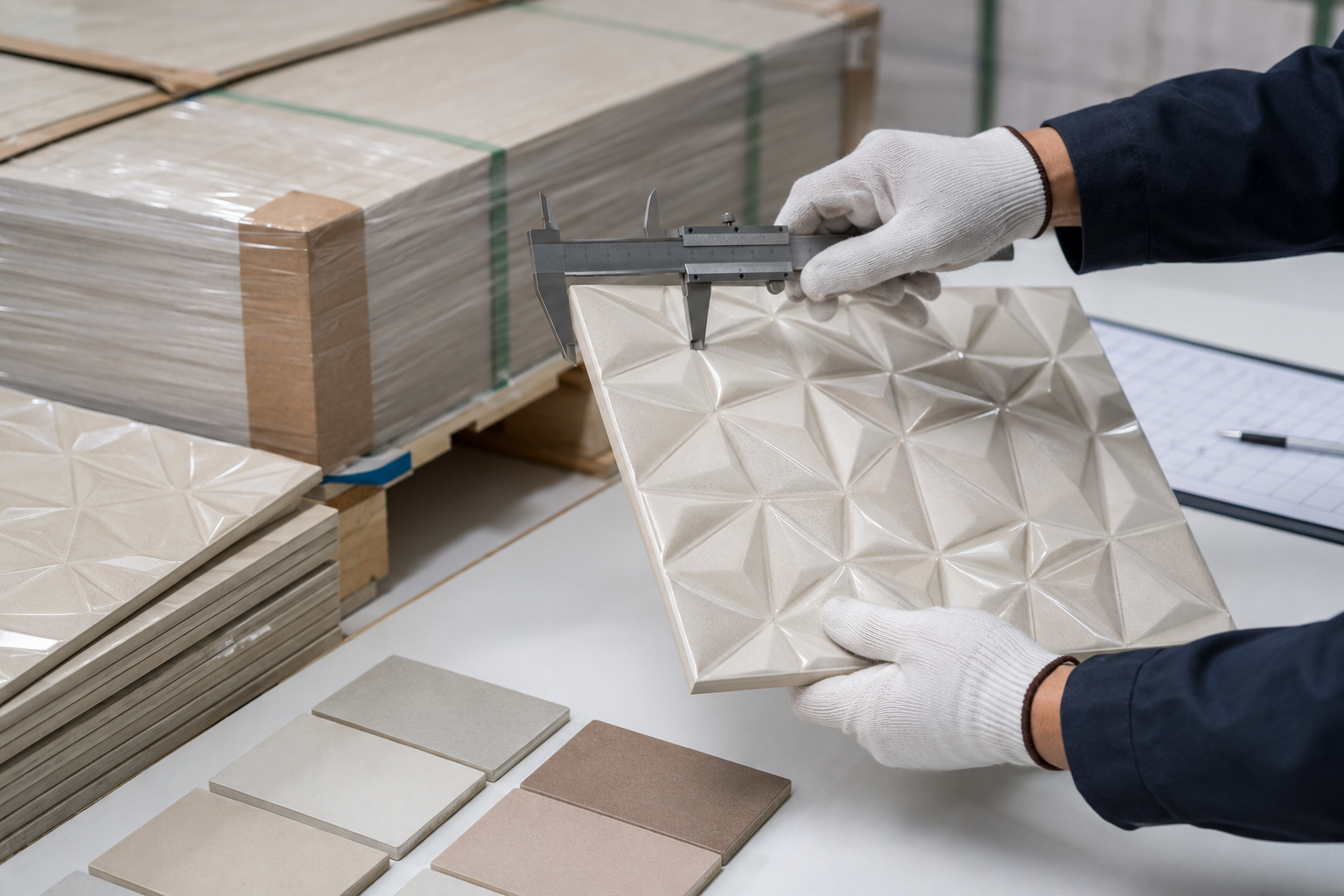
- How will dimensions, thickness, relief depth, and edge quality be inspected across batches?
- How are 3D ceramic tiles checked so the pattern repeats consistently over a larger wall area?
- What carton, corner protection, pallet, and loading method will reduce breakage in transit?
- Which checkpoints connect production timing with the installation schedule?
These details give the contractor a much clearer view of delivery risk than price alone. They also reveal whether the supplier has experience translating design intent into a controlled material program.
OEM and ODM review is part of project readiness
When a project includes custom color, relief, texture, format, or packaging requirements, the supplier conversation needs to go beyond a catalogue. Review the MagiTiles OEM and ODM process for ceramic tile customization to discuss sample sequence, technical approval, quality checkpoints, and delivery coordination before an order is released.
This is especially useful for a 3D ceramic tiles manufacturer. Custom surfaces can look compelling in a small display, but the real question is whether they can be reproduced reliably at the required quantity without unexpected variation or packing damage.
Use standards-based questions to strengthen supplier review
The International Organization for Standardization offers a useful reference point for teams asking about documented quality processes, traceability, and inspection discipline. Contractors do not need to perform a formal audit for every tile order, but they should ask for a clear explanation of how the supplier records approvals, controls variation, and handles an issue before shipment.
This approach also improves comparisons with an alumina ceramic tiles manufacturer or a brick ceramic tiles manufacturer, where material category and technical use can create different review priorities. The supplier should be able to explain the control plan that fits the product, not provide the same generic response for every tile type.
Build an inquiry that supports a reliable quote
A project-ready inquiry should include the tile category, dimensions, finish or relief target, quantity, application area, packaging requirements, delivery location, and required installation date. Reference images and drawings are valuable when the project has a specific visual direction.
When contractors supply these details early, a ceramic tiles manufacturer can provide a more accurate plan for samples, production, packing, and shipment. That makes the final supplier choice more dependable and helps the project move from concept to installation with fewer surprises.