
Choosing a ceramic tiles manufacturer is only the beginning of a project. The harder task is maintaining control from the approved sample through mass production, packing, shipment, and installation. A visually correct sample does not guarantee that thousands of pieces will arrive with the same shade range, dimensions, surface character, labeling, or protection. Project contractors need a documented control chain that turns design intent into a repeatable site result.
This framework organizes that chain into practical gates. It is especially useful for customized wall tiles, relief surfaces, facade modules, mixed-format schedules, and other orders where a small production or logistics variation can disrupt an entire elevation.

Begin with a Project Requirement Matrix
Project control starts before sampling. Convert drawings, specifications, finish references, and site constraints into one requirement matrix that both buyer and factory can review. At minimum, record:
- product code, nominal and work sizes, thickness, finish, and edge treatment;
- intended interior or exterior application;
- module direction, pattern repeat, joint width, and corner details;
- target shade range, texture, gloss, relief depth, and acceptable variation;
- relevant performance requirements and test methods;
- quantities by area, elevation, phase, and required spare percentage;
- packing, labeling, pallet, delivery, and documentation requirements;
- approval owners, inspection points, and corrective-action responsibilities.
This matrix prevents commercial, technical, production, and site teams from working from different assumptions. It also gives the manufacturer a basis for checking feasibility before price and lead time become commitments.
Turn the Approved Sample into a Measurable Standard
An approved sample should function as a production standard, not as a showroom souvenir. Label every retained sample with the project name, product code, finish, date, sample round, and signatures of the approving parties. Where appearance depends on repetition or lighting, approve an assembled panel rather than one isolated tile.
For a 3D ceramic tiles manufacturer, the panel should demonstrate profile depth, module direction, joint rhythm, shadow behavior, corners, and likely variation. Review it under lighting similar to the finished space. Record measurable attributes such as dimensions, warpage, squareness, relief geometry, gloss range, and color tolerance where appropriate.
Keep matching reference sets with the buyer, factory, and site team. The factory copy guides production and final sorting; the buyer copy supports inspection; the site copy helps installers recognize the intended appearance. MagiTiles’ overview of ceramic tile manufacturing and quality-control capabilities can help teams structure this sample-to-production discussion.
Define Production Gates Before the Purchase Order
Do not wait until final inspection to discover a process problem. Build approval gates into the order so that issues are found while correction is still practical.
Gate 1: Pre-Production Confirmation
Confirm drawings, mold or pattern files, body and glaze references, quantities, tolerance tables, test requirements, packing artwork, and the production schedule. Any change after this gate should have a written revision record.
Gate 2: First-Off or Pilot Review
Inspect early production pieces before the full batch is released. Compare them with the signed sample for shade, surface, geometry, edge condition, and assembly. For customized relief tiles, dry-lay enough modules to expose pattern and alignment problems.
Gate 3: In-Process Control
Monitor variables that can drift during forming, drying, glazing, firing, calibration, and sorting. The exact checkpoints depend on the product, but records should connect results to a batch and production time rather than provide an untraceable average.
Gate 4: Pre-Shipment Inspection
Check finished goods against the agreed sampling plan and acceptance criteria. Include product identity, dimensions, visual defects, shade grouping, carton quantity, labels, pallet condition, and shipment documents. Record nonconformities and disposition before loading.
Connect Test Evidence to the Actual Order
Technical reports are useful only when their scope matches the ordered product. Review product designation, construction, finish, test date, laboratory, sample source, and applicable method. The International Organization for Standardization provides an authority reference for internationally recognized standards and terminology, but the project team must still identify which requirements apply to the specific installation and market.
Avoid treating unrelated ceramic categories as interchangeable. Search results for an alumina ceramic tiles manufacturer may describe industrial wear linings, while a brick ceramic tiles manufacturer may supply architectural slips or thin brick systems. Similarly, a ceramic tiles manufacturer in Morbi or a ceramic tiles manufacturer in Bikaner may serve many distinct product segments. Confirm the actual material, manufacturing route, declared performance, and intended application before comparing documents or prices.
Control Batch Consistency and Traceability
Natural production variation must be managed, not ignored. Agree on how shade, caliber, surface texture, and dimensional groups will be sorted and labeled. Each carton and pallet should connect back to a production batch, inspection record, and approved reference.
A practical traceability record includes:
- production date and line or kiln reference;
- batch, shade, caliber, and quality grade;
- inspection lot and sample results;
- carton count and pallet number;
- destination area or installation phase where sequencing matters;
- retained sample identification;
- disposition of repaired, regraded, or rejected material.
Traceability makes corrective action faster and limits disruption. If a problem is isolated to one batch or pallet, the contractor can quarantine it without stopping all material on site.
Make Installation Compatibility Part of Supplier Review
A technically conforming tile can still fail as a project system if the substrate, adhesive, joint layout, movement accommodation, cutting method, or cleaning process is unsuitable. Review installation interfaces early, especially for exterior applications, wet areas, large formats, deep relief, and directional patterns.
The supplier should provide accurate product information and recommended handling practices. Qualified project professionals remain responsible for substrate design, fixing system selection, local code compliance, environmental exposure, and site-specific engineering. This division of responsibility should be explicit.
Completed applications can reveal questions that a datasheet cannot. Review ceramic tile project cases and installed outcomes to discuss layout, lighting, joint treatment, transitions, cutting, access, and replacement planning with the manufacturer and installer.
Treat Packaging as an Engineering Control
Packaging is the last factory process and the first site interface. It must protect the actual tile geometry through stacking, container loading, sea or road transport, unloading, storage, and movement to the workface.
For relief tiles, separators should protect raised profiles without concentrating pressure. Cartons need suitable strength and clear product, shade, caliber, quantity, and directional markings. Pallets should be stable, moisture-protected where necessary, and mapped to help the site team receive and sequence material.
Before loading, request carton photos, pallet photos, gross and net weights, pallet dimensions, container plan, pallet map, and loading records. Define whether mixed batches or shades may share a pallet. Agree on spare quantities and retained stock for future replacement.
Plan the Handover from Factory to Site
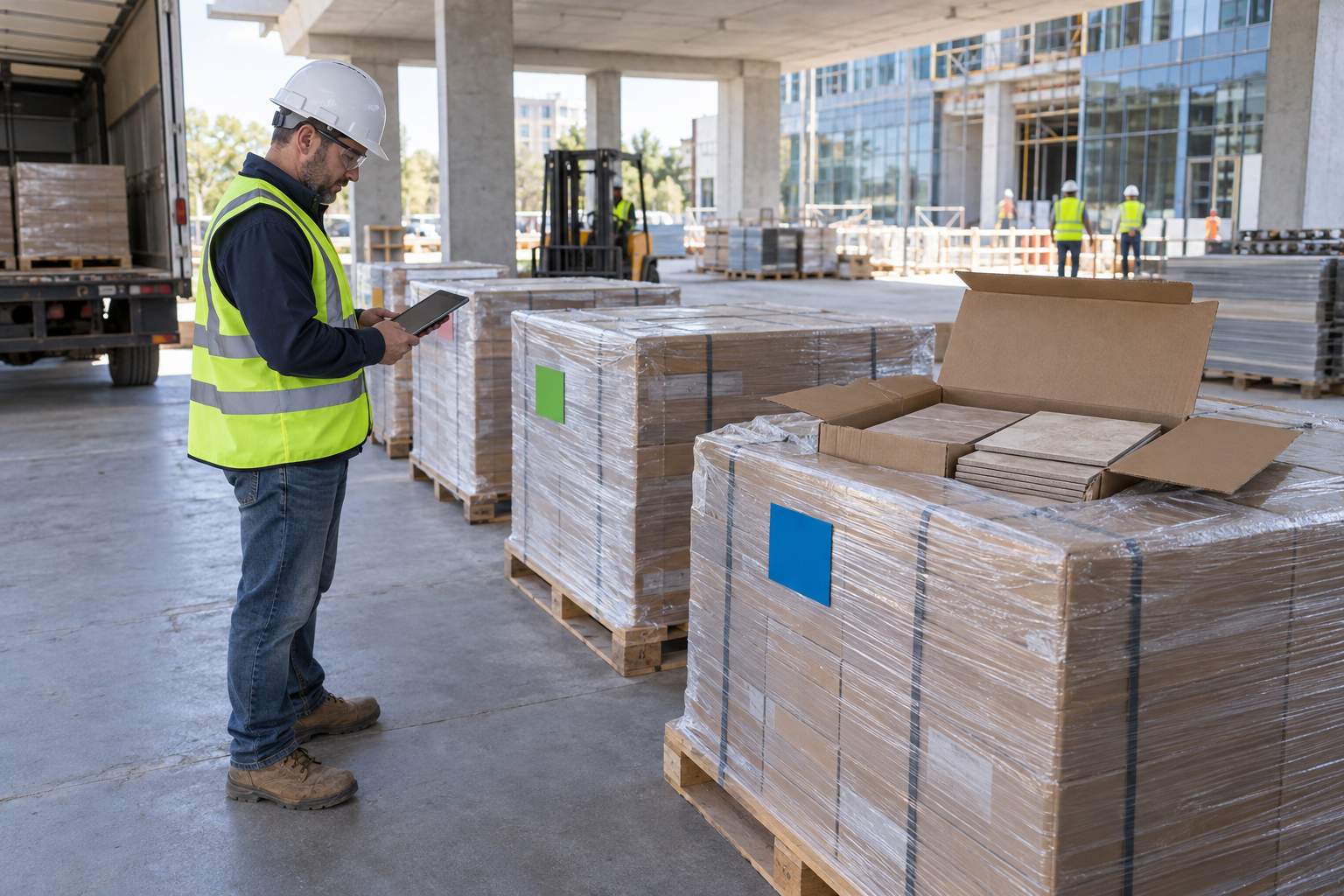
The delivery package should enable the receiving team to verify what arrived. Provide the packing list, pallet map, batch schedule, inspection report, product data, installation notes, and damage-report procedure before the shipment reaches site.
At receipt, check container or truck condition, pallet count, visible damage, labels, batch distribution, and a sample of cartons. Photograph exceptions before materials are moved. Store pallets in a dry, stable area and preserve labels until installation is complete.
For phased work, align pallet numbering with zones or elevations. This reduces unnecessary handling and helps maintain planned shade distribution. It also prevents installers from opening cartons randomly and mixing material intended for different areas.
Use a Contractor-Friendly Control Checklist
Before authorizing each milestone, confirm the evidence required for release.
Before production:
- signed requirement matrix and approved sample set;
- confirmed drawings, quantities, tolerances, and test requirements;
- agreed production schedule and inspection gates;
- approved packing, labeling, and pallet specification.
Before shipment:
- batch-specific inspection results;
- comparison with the retained approved sample;
- shade, caliber, carton, and pallet traceability;
- packed-goods and loading evidence;
- final document package and approved corrective actions.
At site:
- receipt inspection and damage record;
- protected storage and batch segregation;
- installer briefing and trial layout;
- approval of the first completed area before broad installation;
- retained spare material and final batch records.
For additional procurement tools, MagiTiles’ tile sourcing insights for project contractors connect product evaluation with factory qualification, inspection planning, and delivery control.
Move from Product Interest to a Controlled OEM/ODM Inquiry
The strongest sourcing funnel is deliberate: define the product need, examine project evidence, evaluate factory and OEM/ODM controls, then submit a complete inquiry. An actionable inquiry should include drawings, reference images, dimensions, finish or relief target, application, quantity, destination, schedule, performance expectations, inspection needs, packing requirements, and documentation list.
OEM/ODM capability should be demonstrated through a controlled development path: feasibility review, drawing or mold approval, laboratory samples, assembled-panel confirmation, pilot production, mass-production checkpoints, final inspection, and traceable delivery. A logo change alone is not project engineering.
When comparing a ceramic tiles manufacturer, ask for evidence at every gate and name the person authorized to approve release. This creates a clear path from blog research to product definition, from factory and OEM/ODM review to a project-ready inquiry, and from an approved sample to a site delivery the contractor can verify.