A ceramic tiles manufacturer can quote an attractive unit price and provide a technically impressive datasheet, yet still create expensive problems once a three-dimensional tile reaches the project site. For contractors, developers, architects, and procurement teams, the real buying decision sits between the numbers: whether samples represent production, whether tolerances remain stable across batches, whether the relief pattern aligns across a wall, and whether packaging and delivery protect the finish through installation.
This is especially important when evaluating a 3d ceramic tiles manufacturer. A flat tile can hide small variations more easily; a relief tile turns dimensional drift, lighting differences, joint alignment, and edge quality into visible project risks. The right supplier evaluation therefore goes beyond comparing price per square meter and checking a list of nominal specifications.

Why the lowest quotation is not the lowest project cost
Tile quotations rarely show the full installed-cost picture. A low ex-factory price can be offset by sorting time, damaged cartons, inconsistent shades, pattern mismatch, slow replacement production, or additional cutting and adjustment on site. These costs may appear under labor, schedule delay, waste, or rework rather than under the tile purchase itself.
Project buyers should compare suppliers using a total-risk view:
- usable yield after delivery, not only shipped quantity;
- consistency between the approved sample and mass production;
- dimensional tolerance across multiple cartons and batches;
- relief alignment under the project’s intended lighting;
- replacement lead time if damage or shortages occur;
- packaging strength for the actual transport route;
- labeling and pallet logic that support site sequencing.
Start by reviewing the manufacturer’s ceramic tile product range in relation to the application. The goal is not to select a surface only because it looks suitable in a small image. It is to establish whether the format, finish, body, edge, relief depth, and recommended installation method match the wall, floor, facade, hospitality, retail, or residential project conditions.
Datasheets define a target, not production consistency
A specification sheet is useful because it creates a common technical language. However, it usually describes declared characteristics or test values, not the consistency of every production lot. Two suppliers may list the same size, thickness, water absorption class, or surface finish while operating very different controls for tooling, firing, shade sorting, calibration, and final inspection.
When comparing a ceramic tiles manufacturer in Morbi, a ceramic tiles manufacturer in Bikaner, or suppliers in other production regions, avoid treating location as a quality shortcut. Regional manufacturing scale can influence product availability and logistics, but project reliability still depends on factory-specific process control, documentation, sampling discipline, and communication. Verify the production system behind the certificate or claim.
Internationally recognized management and testing frameworks can help buyers structure due diligence. The International Organization for Standardization is an appropriate starting point for understanding standards, but a certificate alone does not approve a specific tile for a specific project. Buyers should confirm the certificate’s scope, issuing body, validity, relevant product family, and the test methods used for the submitted sample.
What to inspect in a 3D tile sample and mock-up
The approval sample should be the beginning of validation, not the end. Ask for multiple pieces from a representative production or trial batch and assemble them in the intended orientation. View the mock-up from normal walking distance and under both diffuse and raking light. Relief tiles can look consistent from the front yet reveal misalignment or surface waves when light crosses the wall.
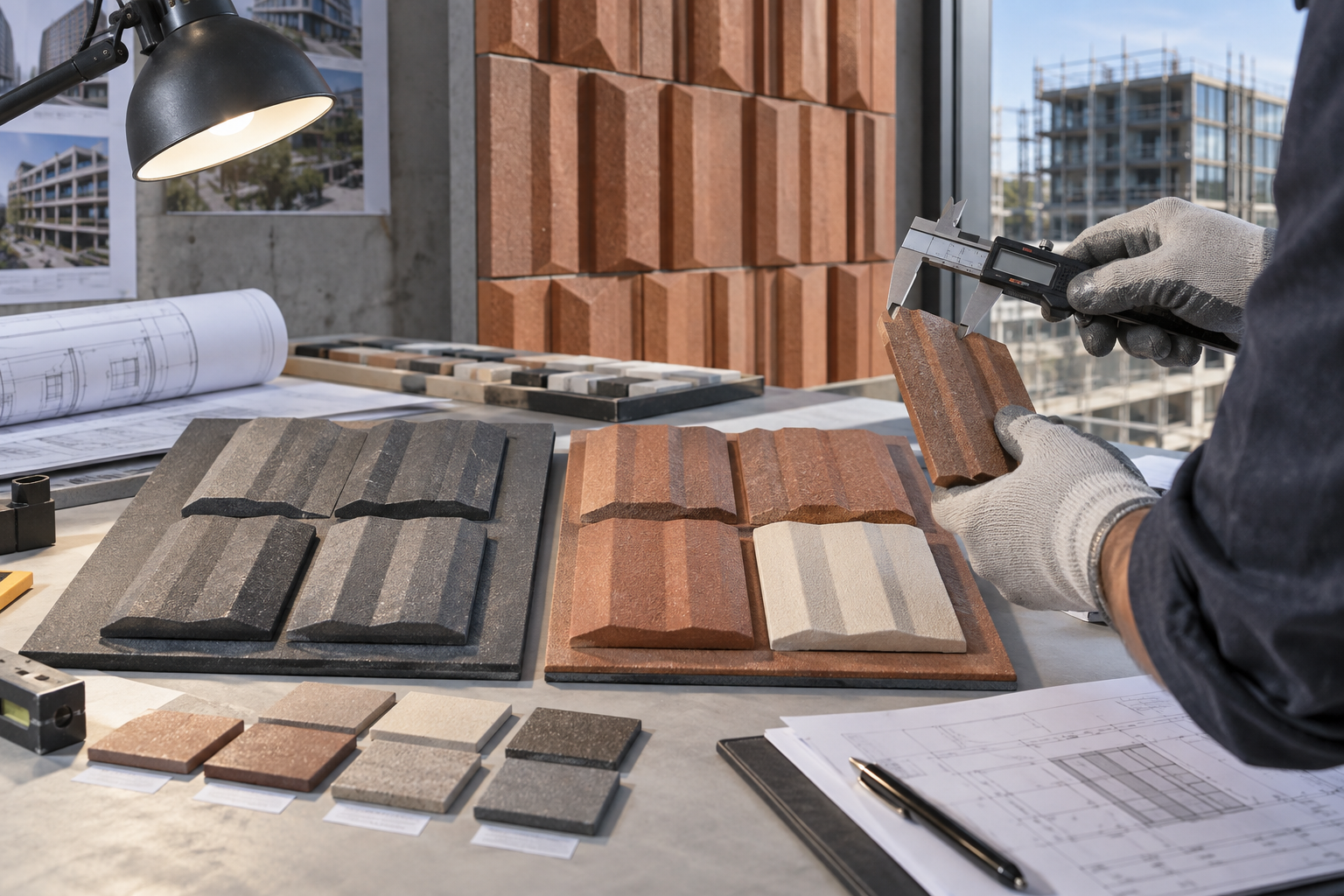
Record the agreed acceptance points in a sample approval sheet:
- Overall length, width, and thickness tolerance.
- Relief depth and repeatability of the 3D pattern.
- Edge straightness, squareness, and corner integrity.
- Shade, gloss, texture, and glaze coverage under controlled light.
- Pattern direction and the relationship between adjacent modules.
- Recommended joint width, adhesive bed, substrate flatness, and cutting method.
- Reference photos and signed sample identification.
This inspection discipline also clarifies category differences. An alumina ceramic tiles manufacturer typically serves demanding technical or wear-resistant applications where material composition and performance evidence are central. A brick ceramic tiles manufacturer may focus more on modular facade or wall systems, where size variation, water behavior, freeze-thaw exposure, bonding, and joint design can drive the decision. A decorative 3D wall tile requires its own acceptance logic around visual continuity and lighting. Similar words in a search result do not mean the products are interchangeable.
Ask how the manufacturer controls the production batch
For dimensional tiles, project buyers should understand the production checkpoints rather than accepting a generic statement that quality is inspected. Useful questions include:
- How are incoming raw materials and color inputs identified by lot?
- How often are molds or dies checked for wear?
- Which dimensions are measured during production, and at what frequency?
- How are shade and surface defects classified during sorting?
- Can cartons and pallets be traced to a production date or batch?
- What happens when inspection results approach the tolerance limit?
- How is the approved sample retained and compared with production?
A credible manufacturer should be able to translate these questions into a practical control plan. That plan need not expose confidential process details, but it should show who checks what, when evidence is recorded, and how nonconforming material is isolated.
For custom relief, color, format, carton, or project labeling, use the manufacturer’s ceramic tile OEM and ODM capability as the next evaluation stage. A customization discussion should confirm tooling responsibility, drawing revision control, sample approval gates, minimum order requirements, production lead time, color limits, packaging tests, and ownership of replacement inventory. This turns an attractive concept into a controlled production brief.
Build a project-specific approval gate
A robust sourcing process can be organized into five gates.
1. Application definition
State the substrate, indoor or outdoor exposure, service conditions, cleaning regime, traffic or impact expectations, installation height, lighting direction, and local code requirements. The same tile may perform differently in a dry lobby, a wet area, or an exposed facade.
2. Document review
Compare drawings, technical data, relevant test reports, certification scope, installation guidance, packing method, and commercial terms. Note which values are guaranteed, typical, or dependent on the selected construction system.
3. Physical sample and mock-up
Inspect several pieces, assemble the repeat, photograph the accepted appearance, and record measurable tolerances. For a 3D pattern, approve both individual tile quality and the visual field created by multiple modules.
4. Pre-shipment evidence
Agree on production photos, batch identification, inspection sampling, carton markings, pallet layout, spare percentage, and loading records. If third-party inspection is required, define the sampling plan and acceptance criteria before production rather than after goods are ready.
5. Delivery and issue response
Confirm shipping milestones, document responsibility, unloading constraints, site storage, shortage reporting, and replacement lead time. A supplier’s ability to coordinate corrective action can matter as much as the initial defect rate when the installation program is tight.
Compare offers with a weighted scorecard
Instead of allowing price to dominate the decision, assign weights that reflect the project. A typical scorecard might allocate 25% to product and test fit, 20% to batch consistency, 15% to sample and mock-up performance, 15% to packaging and logistics, 15% to technical communication, and 10% to commercial price. A highly price-sensitive project can adjust the weights, but the scoring makes hidden assumptions visible.
Record evidence beside every score. “Good quality” is not evidence; a signed mock-up, batch traceability example, verified test report, packing specification, or response-time commitment is. This also makes it easier for design, procurement, site, and commercial teams to reach the same decision.
From tile idea to controlled project supply
The most suitable supplier is not simply the one with the longest specification sheet or the lowest quotation. It is the one that can connect design intent, measurable acceptance criteria, stable production, protected delivery, and responsive project coordination.
For a live project, move through the sourcing funnel in order: compare the relevant MagiTiles product range, define custom or project requirements with the OEM/ODM tile team, and then send your drawings, quantities, application, and delivery schedule. A clear brief enables a ceramic tiles manufacturer to respond with a more useful sample plan, quotation, and risk-control proposal—not just another price per square meter.